Part 3: Atami — Geisha, Group Tourists, and Me, the Innkeeper's Child
On weekends, several sightseeing buses would pull into the inn's parking lot.
As a child, I would watch, almost absentmindedly, as crowds of tourists filed out one after another.
That was simply the ordinary scene of a weekend.
The banquet hall was always lively.
Groups of visitors on company trips would gather there in the evening for banquets.
Dishes were carried in, drinks were poured, and the sound of laughter and clinking glasses drifted all the way down the hallway.
As a child, that liveliness felt like the "world of adults"—something I watched from a bit of a distance.
The geisha and the hostesses were people I would only pass by at the front desk.
I barely remember ever speaking with them.
Even so, the sight of women in kimono coming and going through the entrance
wasn't anything special to a child—it was just part of everyday life.
There was always a sense of someone's presence near the entrance, and the whole inn seemed to move like a single living creature.
That kind of daily life repeated itself, weekend after weekend.
Summer, Fireworks, and Shouts of "Tamaya!"
Summer, in particular, was always bustling in my memory.
The fireworks festival, too, used to last much longer than it does now.
The fireworks would spread across the entire length of the breakwater,
filling it with light from one end to the other.
The display itself would go on for nearly an hour.
Every time a firework burst, shouts of "Tamaya!" would rise up from here and there.
On the rooftop of the inn, seats were set up for watching the fireworks.
Guests in yukata would gather there,
looking up at the light spreading across the night sky.
A rooftop packed with people, shoulder to shoulder, was just an ordinary summer sight.
When the fireworks ended, applause and cheers would rise from the rooftop,
and sometimes that was the cue for a second round of festivities to begin in the banquet hall.
Summer in Atami was the season when the entire inn came most alive, year after year.
The Bustle of Year's End
The town had energy at the end of the year, too.
My detailed memories of it have faded,
but the feeling that "the year-end was lively" still remains with me.
I remember how the inn's reservations would fill up as New Year's Eve approached,
and the adults around me looking busy and a little frantic.
The Bubble Bursts, a Quiet Change
I can't say exactly when Atami began to change.
There wasn't a single, clear moment when it happened.
But sometime after the bubble economy burst,
I began to sense that the number of group tourists was gradually decreasing.
It wasn't a dramatic shift.
It happened quietly, little by little.
Before I knew it, the parking lot that used to be crowded with buses on weekends
had fewer and fewer of them.
The lights in the banquet hall seemed to go out earlier than they used to.
Looking back, I think that was the beginning of a long, slow change.
Watching the Same Fireworks, Now
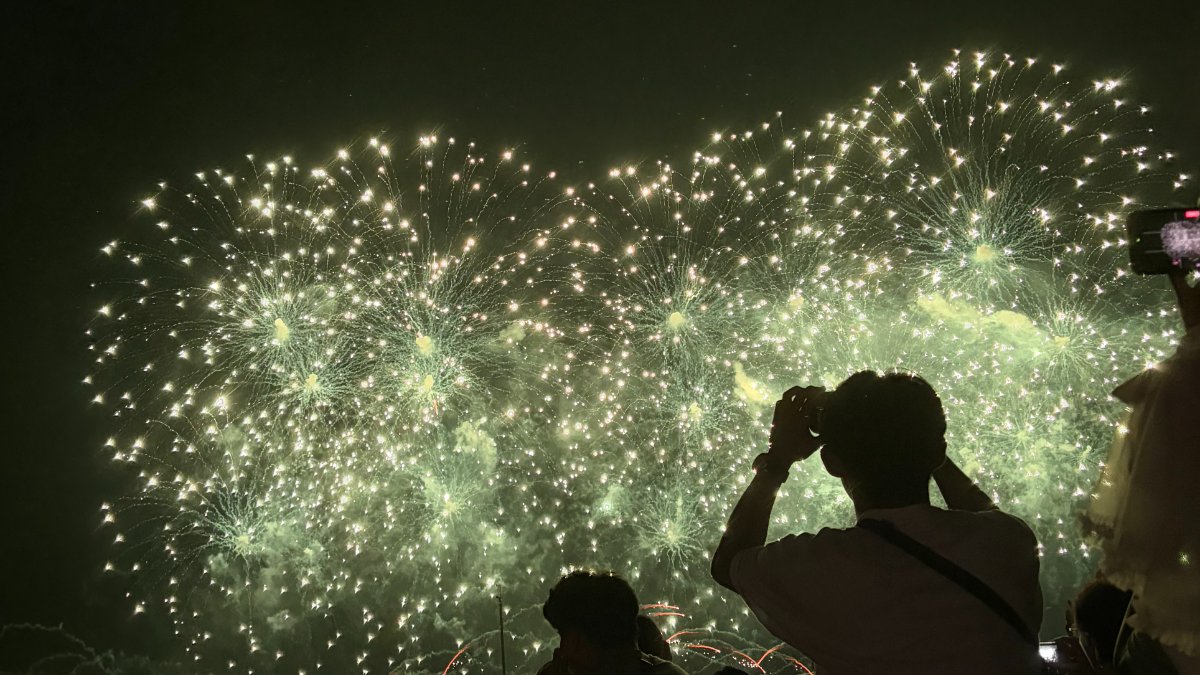
Last week, I went to see the Atami fireworks for the first time in a long while.
As a child, the fireworks used to spread across the whole breakwater.
They were launched so as to fill the sky from one end of the sea to the other.
The fireworks I saw this time covered only about half that width.
The duration had changed too.
What used to last nearly an hour now ends in about twenty minutes.
Perhaps, in exchange, the number of festival days has increased.
By spreading things out over more days, they're probably managing to keep the tradition alive.
Watching the fireworks—narrower in width, shorter in duration—
I felt a small pang of sadness.
Maybe it's precisely because I knew Atami the way it used to be that I feel this way even more strongly.
And yet, as the fireworks were about to begin,
people still gathered along the shore.
Even with a smaller scale, there are still people who come to watch.
Watching that scene, I found myself thinking:
I wish more people would come.
I'd love to see, once again, the breakwater lined edge to edge with people, just like it used to be.
That's not simply nostalgia—
it's also a hope for what Atami can become.